← All states EN ES RU
CALIFORNIA DMV · WRITTEN TEST (CLASS C)

Road Ready CA › Topics

Right-of-way and traffic signals: California DMV written test practice

Rules to understand before practicing

Decide who must yield before entering an intersection. At a four-way stop, the first vehicle to stop normally proceeds first; if two arrive together, the driver on the left yields to the driver on the right. A left turn on a regular green light requires a gap in oncoming traffic and attention to pedestrians. A green arrow still requires you to avoid people or vehicles already in the intersection. A common mistake is treating a green signal as permission to enter a blocked intersection. Wait until there is room beyond it.

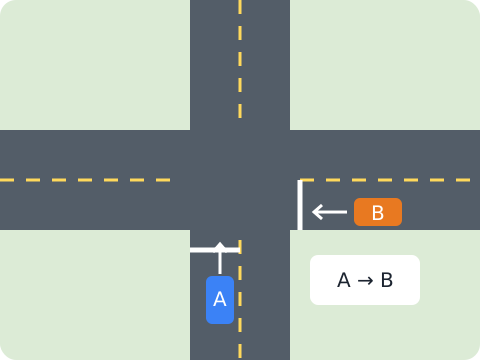
A and B stop at the same time. A yields because B is on A’s right.

Official reading for this topic

Start free practice

6 free practice questions on right-of-way and traffic signals for the California DMV written knowledge test, each with the correct answer and a short explanation. Study them here, then check yourself in the interactive quiz or the exam simulator.

Take the free practice test →

About the California written test

36questions on the real test for adults
30 / 36correct answers to pass (~83%)
3attempts before you must reapply

Take the free practice test →

More topics

1. Two cars approach a four-way stop sign at the same time. Which one goes first?

  1. The car on the left
  2. ✓ The car on the right
  3. A larger car
  4. Who will honk first?

Explanation: If vehicles arrive at the same time, the driver on the right has the right of way.

Official reading · set1-007

2. When is it permitted to make a right turn on a red light in California?

  1. Never—it's always prohibited.
  2. ✓ After coming to a complete stop, unless there is a sign prohibiting turns
  3. Only outside the city
  4. Only if there are no other cars nearby

Explanation: Turning right on a red light is permitted statewide after coming to a complete stop, unless there is a “No Turn on Red” sign.

Official reading · set1-008

3. You must yield to pedestrians:

  1. Only at marked crosswalks
  2. ✓ At both marked and unmarked crosswalks at intersections
  3. Only if they are children or the elderly
  4. Only during daylight hours

Explanation: By law, every intersection constitutes a crosswalk, whether it is marked or not, and pedestrians have the right of way there.

Official reading · set1-009

4. A flashing red traffic light is equivalent to:

  1. At a "Yield" sign—slow down and proceed with caution
  2. ✓ At a "Stop" sign—stop, then proceed when it is safe to do so
  3. A faulty signal that can be ignored
  4. Green light for cross traffic only

Explanation: A flashing red light should be treated the same way as a "Stop" sign: come to a complete stop and proceed only when it is safe to do so.

Official reading · set1-010

5. At an intersection with no signs or traffic lights, two cars approach at roughly the same time. Who yields?

  1. A slower car falls behind
  2. ✓ The driver must yield to the vehicle on the right
  3. The driver going straight always has the right of way
  4. No one is obligated to give in to anyone else

Explanation: The same rule applies as at an intersection with “Stop” signs in all directions: yield to vehicles approaching from the right.

Official reading · set1-011

6. When merging onto a freeway, who usually has the right of way?

  1. A car that is changing lanes
  2. ✓ For vehicles already traveling on the highway
  3. The one who drives faster
  4. It depends on the size of the car

Explanation: Vehicles already traveling in the main lane have the right of way; drivers merging into the lane must adjust their speed and leave a safe following distance.
Official reading · set1-012

Related topics

Content updated October 4, 2026 · How we review content